For most people, usually, when you invite them to play a game, they only have the idea of competition. Like the point of a game is to beat the other players. Nowadays, there are already a lot of games where all players have to work together toward the same goal. In that kind of games, all players win or lose together.
But there is a 3rd kind of games called semi-cooperative games. Just as an example, in this kind, players are still competing against each other but maybe there is a common threat. This common threat may be an obstacle to one or more players. Unless the players work together, they cannot overcome this obstacle, let alone achieving their own goal.
Some people don’t like that idea because there is a possibility that one player do a lot more to overcome that obstacle and yet the other is the only winner. Of course, this depends on the design but usually they would rather just play complete cooperative or competitive.
Moytura is one of these semi-cooperative games. In this one, players are competing factions trying to take control of ancient Irelands. However, there is a common enemy that may prevent one or both players from reaching their goals. So, will you cooperate or work on your own to become the High Ruler of Ireland?
Title: Moytura
Year Released: 2026
Designer: Trevor Benjamin, David Thompson
Publisher: Bitewing Games
Artist: A. Giroux, Harry Conway
Genre: War, Celtic Mythology, Ireland, Area Movement, Area Majority, Semi-Cooperative, Official Solo Mode, 1-2 players
Overview
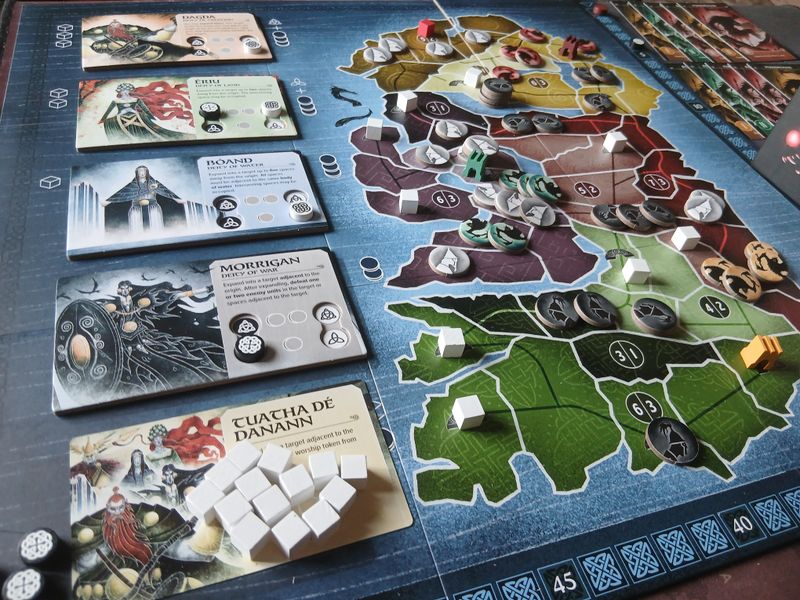
In Moytura, the 2 players are controlling their troops to stop the 3 expanding enemy factions across Ireland. With the help from the same 4 deities, each player can expand their troops in 4 different ways.
On their turn, the player has to choose a deity, pay enough worship tokens in order to gain the ability of that deity. However, right after that the cost to gain help for that deity goes up while pushing the other deities down, even though the effect of their power increases. This means, the next player will have different effect and cost to choose.
Eriu, the Deity of Land, allows you to expand up to 2 spaces from your source. Boand, the deity of Water lets you expand up to 5 spaces from your source, as long as the target location is connected by the same body of water.
Morrigan, the Deity of War, lets you beat enemy on the same location as your target expansion or adjacent to it before the conflict happens. Dagda, the deity of Creation, lets you expand twice just to an adjacent location of 2 different sources. The first target cannot be the source of the 2nd.
Usually when expanding, you add 2 troops total plus the upgrade for free if the deity is at the lower level. If the deity is at the 2nd level, you have to pay a token and add 3 troops plus your upgrade. At 3rd level, you pay 2 tokens, adding 3 troops plus upgrading the lower power. While at highest level, you have to pay 3 tokens, you add 3 troops plus the upgrade from the higher level.
Once you have upgraded, you don’t need to upgrade again but the cost remains the same as the position of that deity. The upgrade means you either add 1 extra troop for the lower power or 2 extra troops for higher while expanding.
When you expand the troop to an area with enemy, conflict happens. Basically, you remove one enemy and one of your troop until there is only one faction left in that area. Players cannot expand to an area already with the opposing troop or the area with enemy strongholds.
If you remove 3 enemies during your turn, you may exchange them into worship tokens. After that, then it’s the other player’s turn. They do something similar, choose a deity, pay the cost and expand their troops.
Then, it is time for the enemy’s faction to expand. For this, you basically reveal the top card of the enemy deck. This will tell you which enemy faction will do the expanding and how many of their troops will reach the new region.
When expanding the enemy, you have to pick the biggest group of space with that enemy faction as the source. Then following the line connected to all of the spaces in that area, you then add one or 2 more troops of that enemy faction. It is possible they enter an area with one of the player’s troop. In that case, a conflict happens, and you similarly remove the troops from both. However, that player won’t take any enemy tokens.
So, you do that 5 times, first player takes action, followed by the 2nd and resolve the enemy card. That then concludes one of the 2 phases. At the end of each phase, you tally your majority score.
The map is divided into 11 regions. Some are bigger than others. The faction with more troops in any region wins the majority and gain higher points of that region. This is between the 2 players and any of the enemy. If there are tied factions, they just divide the total of two top scores of the region.
Also, if any player wins the majority of a region with one of the enemy stronghold, they get even more points. So, you calculate the score for all 11 regions and then proceed to the phase 2.
In phase 2, you do the same 5 rounds with a new enemy deck. At the end of that phase, you score again all of the 11 regions. Maybe the situation has changed. Some factions win more; some others lose more. Whoever scores the most points between the 2 players wins. They both lose the game if the enemy’s score is tied with the higher between the 2 players.
This is just the general idea of how you play Moytura, competitively or semi-cooperatively.
The game also has a rule to play cooperatively and solo with just small change. Basically the enemy will gain more points and you can only win cooperatively if both players’ faction score higher than the enemy.
The game also comes with 3 different adversaries. Instead of 3 generic enemy factions, you get to change up to 3 of them with special clans. These enemy clans will expand differently. Like some may expand to an area not connected by path or instead of expanding, they spawn to specific location.
Session Reports
October 2026 session and more pictures of that session on Instagram and Tumblr.
So, this was my first time playing the game and I got 3 sessions. One for competitive playing 2-handed and then I tried the cooperative variant twice with the 2nd higher difficulty.
The result of the first game was the White player won with 52 points while Black had only 50 with the enemy only had 28. White upgraded on two deities, one the top and one at the second power. Black upgraded on 3 deities, all for the 2nd power. This was using the introductory map.
I noticed that winning the area with the intersection was very crucial to limit the expansion of the enemy. This was the part that feel like playing Spirit Island. If you manage to remove enemy at all from there or making it not the source of their expansion, they you can handle them better.
After that, I played the cooperative play with the other side of that map card. White started at the top half of the map and Black took the other with the enemy had red at the top, green and then yellow at the bottom.
The result was white scored 51 and black only got 35 with the enemy having 46. So, I lost the game. Somehow Black only upgraded once with white upgraded on 3 deities. I guess you really need to balance both instead of just focusing on one. Green enemy was all wiped out. Red had only 3 in their stronghold region with the white winning the majority. Yellow still won by 2 pieces against the Black in their stronghold region.
So, I played again using the same map but the two starting positions were swapped between the two players. The enemies were the same, red, green yellow from top to bottom.
Well, this time, Black scored 54 but white only scored 35 with the enemy scored exactly 50. So, this was actually worse than my previous session. Well, you can kind of see that there are more enemies left on the board, 4 yellows, 5 greens and 6 reds.
White even upgraded 3 times, one for the top and 2 for the bottom power. Black upgraded only twice, one for the top and one for the bottom power.
At the end of 1st phase in this session, White scored only 15, Black with 20 and the enemy got to 30. So, black definitely got more with extra 34 during phase 2, while white and the enemy both exactly got 20.
In the previous, at the end of first phase, white scored only 17, black with 14 while the enemy got 35. That means, the enemy got only 11, black got 40 and white got 18 from second phase. But it felt more like luck considering no red attack for the white and only weak attack for yellow to black. Although they managed to completely destroy the green even with 3 expansions.
In this session, the Red enemy cards showed up 4 times and that was the enemy closer to the White. Yellow enemy which was closer to Black also showed up 4 times. That means the green was only twice.
The difference is that both red cards showed up in the first phase were the two stronger cards. While Yellow had one strong and one week per phase.
Compared this to the previous session, that session had red only twice while green and yellow had 4 each. Black definitely had it harder especially when the 2 yellow in the first phase were the stronger ones.
So, the real challenge of this game for the cooperative is more about how you can balance between the 2 sides. Sometimes the other side is ready to upgrade with 3 cubes. But then you use a different deity and now the other side can no longer upgrade. While you do want to have ideally 3 cubes all the time but without longer term planning, you are going to deplete them for using something else.
You have to properly plan between the two. Instead of the first one just doing their own thing without thinking the effect of the 2nd in turn.
Also, I probably should have used Dagda more, especially to win majority in more areas. But it felt like a waste unless you upgraded the higher power and add more troops. Otherwise, you expand but right after that, the enemy remove you as well.
The extra starting enemies definitely have impact. Where with lower difficulty as in playing competitively, you just need 2 and remove the enemy next to stronghold and still had troop. Now you need more.
Moving to an area where it is connected to a lake shared with other regions can be crucial as well. You can take advantage more with the Deity of Water.
Overall, I definitely enjoy what you are doing in this game. It somewhat really feel like a super streamlined Spirit Island, like my first Spirit Island. However, I am not a big fan that this was about scoring from those area majority. It is not really inspiring when you then calculate your score and the only way to win is for one player win less to help the other.
That is the rule for the cooperative that you both need to have higher score individually. Compared that to Spirit Island, it is possible that one Spirit may have struggled more during the game but the point is just to defeat the enemy by destroying their stuff. This one felt like you may gain more score just because you got it easier while the other worked harder and got punished for it.
Maybe I’m just not that good yet in figuring out how to balance between the two in playing cooperatively. Well, I’m excited to play more. Let’s see if with more plays I get better and change my view with this cooperative or solo.
More unboxing pictures of Moytura on my Instagram.